
Server-side tracking sends conversion events to ad managers from the server, supplementing the browser pixel. For affiliates, it can help record sales that don't appear in managers, as long as checkout, consent, integrations and attribution are considered. Differences between reports require investigation and do not alone prove the cause of the loss.
A sale can exist at checkout and on the affiliate platform without appearing in Google Ads or Meta Ads. For those who invest in media, this absence leaves the algorithm without a signal used to adjust bids and audiences. The first step is to compare approved sales and events recorded in the same period.
The Ratoeira website states that server-side tracking recovers25% to 40% of conversions. For this article, this number is a reference published by the platform itself, not a result of an independent study. Variation depends on browser, consent, checkout, integrations and attribution criteria; Therefore, each operation needs to compare approved sales with managers' records. A difference between reports may highlight measurement flaws, but does not in itself prove that all missing sales were caused by the pixel. Diagnosis needs to consider comparable data and period and document how platforms count sent events.
I got to know this problem up close by designing theRatoeira Hub, a server-side tracking, anti-fraud and landing page platform for affiliates and paid traffic advertisers. I took care of the product and website experience, and for that I spent months immersed in the daily lives of those who make a living running campaigns on Google Ads, Meta Ads, Taboola and NewsBreak. This article is the guide I would give to any affiliate who still runs only with pixels: why the pixel died, what real server-side tracking is (without the jargon), how double sending and enriched data recover lost conversions, how the anatomy of a click tracked from ad to commission works, why anti-fraud pays for itself and how all of this was architected into a real product that today serves more than 2,600 advertisers.
Why did the pixel die for affiliates?
The pixel didn't die all at once. It was hanged slowly, by four different hands, and most affiliates only noticed when the CPA started to rise without explanation. It is worth understanding each of them, because each one requires a different response, and there is no way back from any of them. Anyone waiting for “the pixel to return to normal” is waiting for something that won't happen: the direction of the entire market is less tracking in the browser, not more.
iOS and App Tracking Transparency
When Apple launched theApp Tracking Transparency, in 2021, the notice asks the person to authorize tracking between apps and websites and access to the device identifier. Each person decides whether to authorize tracking according to the options displayed by the system. For advertisers, an opt-out limits identifiers used in attribution across apps and sites; Platforms also offer other forms of measurement. Selling can happen even when certain signals are not available; This does not mean that every conversion will no longer be recorded. The effect depends on authorization, settings, consent, rules of each platform and implementation. This effect must be evaluated with data from each campaign and available signals.
Ad blockers and the death of third-party cookies
Ad blockers can prevent the pixel from loading, and privacy restrictions change the signals available for attribution. The Safariblocks third-party cookiesby default and WebKit limits stores created by scripts; Firefox also offerscross-site tracking protections. NodeChrome, third-party cookies remain available, with controls and blocking by default in incognito mode. This does not mean that every visitor will go unmeasured nor that sales will become invisible. The effect depends on the browser, the person's settings, consent, domains, and implementation. Therefore, loss estimates need to come from operation data, not a universal percentage.
ITP: Safari shortening memory
THEApple's Intelligent Tracking Preventiondeserves its own paragraph because he attacks even those who think they are protected. ITP limits the lifetime of first-party cookies created via JavaScript to anywhere from 24 hours to 7 days, depending on the scenario. Translation: the user clicks on your ad on a Monday, returns the following week directly via the saved link and purchases. For you, it's the same person, the same journey, the same campaign. For Safari, it's a stranger. The attribution dies along the way and your campaign loses credit for a sale it generated. In a market where the buyer decision cycle often exceeds a week, this is no exception; It's routine.
The checkout redirect that breaks the session
This is the specific killer of the Brazilian affiliate, and the least discussed. The typical journey of an affiliate sale does not happen on a single website: the user leaves the ad, lands on your page, clicks on the offer button, is taken to the Hotmart, Kiwify, Eduzz or similar checkout, pays, and only then does the conversion occur. Each of these jumps is a chance for the crawl to die. The click was born with parameters in the URL; in some redirect along the way, the parameters are lost, or the domain changes and the first-party cookie does not follow, or the checkout runs in an environment where your script cannot even exist. The session breaks, and the conversion becomes an orphan: the affiliation platform knows that it sold, but is unable to return this information to Google or Meta. This is why tracking for affiliates is a more difficult problem than tracking for your own e-commerce: the affiliate does not control the checkout, and that is precisely where the sale takes place.
Combine the four forces and the conclusion is inevitable. It's not that the pixel is misconfigured on your account; is that the environment in which it was invented no longer exists. Continuing to run paid traffic operations depending on it alone, in 2026, is measuring a fever with a broken thermometer: the number appears, but it doesn't mean what you think it means.
Anyone who doubts the size of the hole can do the cheapest test in the world, which I recommend to any affiliate before discussing the tool: open the affiliation platform, add up the approved sales in the last thirty days coming from paid traffic, and compare with the conversions that Google Ads and Meta Ads recorded in the same period for the same campaigns. The difference between the two numbers is your allocation hole. In your own e-commerce operation, this difference is usually small. In affiliate operations with external checkout, it’s scary. I saw this comparison made dozens of times during the Ratoeira Hub project, and the reaction was always the same: first incredulity, then that silent mental calculation of how much money had already been optimized based on a third of the truth.
What is real server-side tracking, without the jargon?
Take away the scary name and the idea fits into one sentence: instead of the visitor's browser counting the conversion for Google and Meta, your server counts it. In the old model, the pixel is a script living in the user's browser, subject to everything we saw in the previous section: blocker, ITP, dead cookie, broken session. In the server-side model, your server is the one who talks to the ad platform server, from machine to machine, through the Conversions API. No ad blocker in the world blocks a request that leaves your server, because it doesn't even pass through the visitor's browser.
The flow looks like this. The user clicks on the ad and arrives at your page with the click identifiers in the URL: Google's gclid, Meta's fbclid, plus your campaign parameters. Your server records this click with all this data. The user browses, clicks on the offer, goes to checkout and purchases. The affiliation platform confirms the sale, and its server, which saved the link between that click and that visitor, triggers the conversion event directly to the Google Ads and Meta Ads Conversions API, loading the original identifiers. The ad platform receives the conversion, matches it with the click it recorded in the auction, and the circle closes: the algorithm learns that that ad, that audience and that creative generated real sales.
What changes in practice is the nature of the data. Client-side, the conversion is a rumor that the browser tells when it succeeds, if it succeeds. Server-side, the conversion is a record that leaves a machine you control, with proof of origin. It's the difference between relying on the memory of a distracted witness and having a security camera. And there is one detail that the affiliate understands immediately: as shipping does not depend on the buyer's browser, redirecting the checkout is no longer a deadly problem. The sale confirmed on the platform returns to your server through integration, not because the cookie survived the trip.
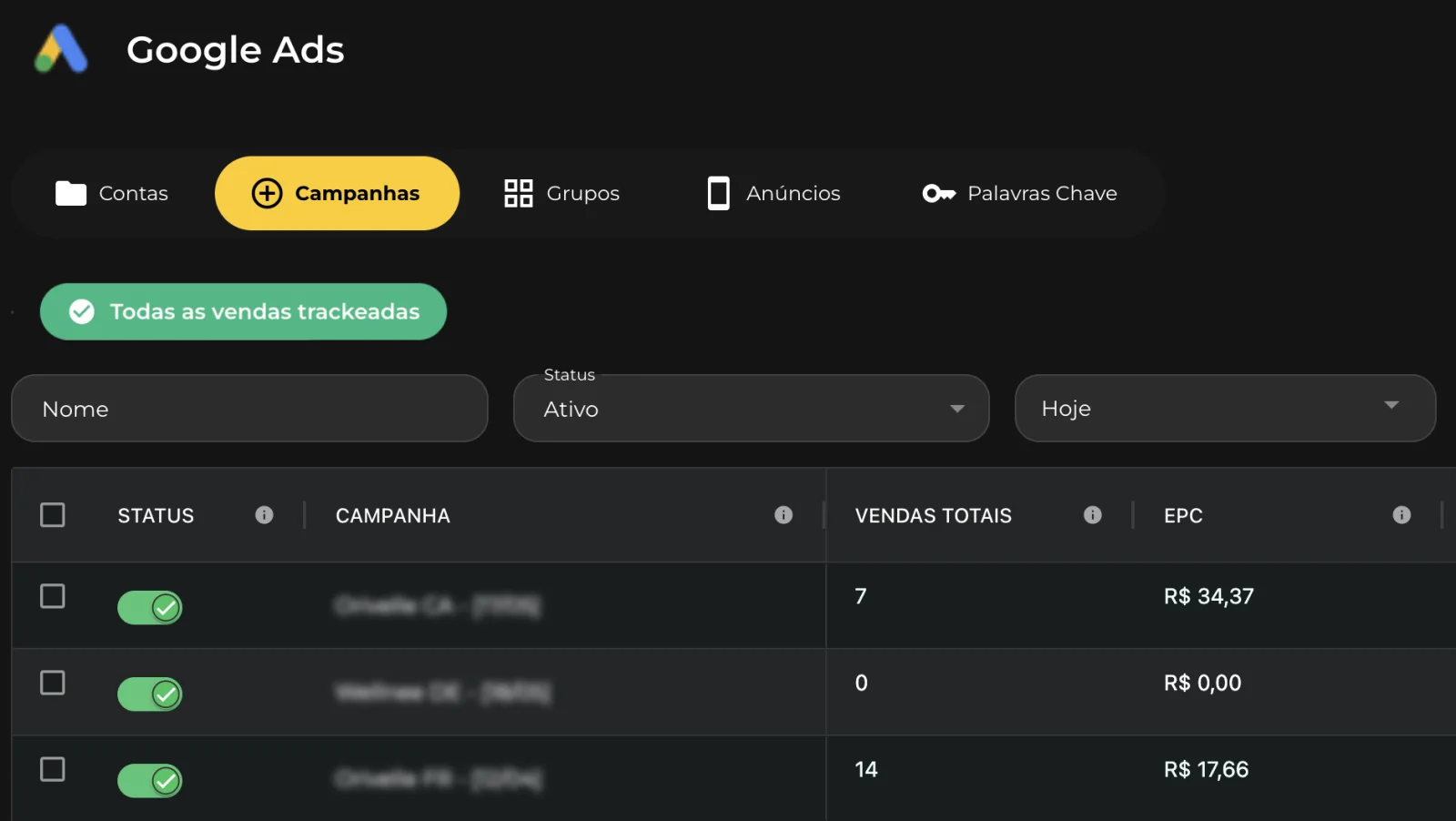
An important correction to common sense: server-side tracking is not “tracking without consent” nor a trick to bypass privacy. Personal data transmitted, such as email and telephone, is hashed, and the legal basis remains the same as that of any media operation. What changes is architecture, not ethics. What the server-side recovers is not the ability to spy on anyone; it's the ability to measure what you've already paid to measure.
It's worth clearing up another common confusion: server-side tracking is not synonymous with “installing Google Tag Manager server-side”. GTM on a server is one of the ways to do this, useful for e-commerces with a development team, but it assumes that you control the entire site from end to end, including checkout, which is simply not the affiliate's world. The affiliate needs a tracking layer that starts at the ad click, goes through pages they control and checkouts they don't control, and returns the conversion to multiple ad platforms at the same time. It's a different product design, and it was exactly this design that structured Ratoeira Hub.
Double Sending and Enriched Data: Where Do Lost Conversions Return?
A mature implementation of server-side tracking does not throw away the pixel; she puts him to work in pairs. It's called double sending: the conversion event goes out through the browser (pixel) and the Conversions API (server) simultaneously, with a unique event identifier that allows the platform to deduplicate. If the pixel fired, great, the server confirms it. If the pixel is blocked, the server delivers it alone. You stop relying on a single fragile messenger and have real redundancy, the kind of redundancy that any engineer would demand from a system that moves money.
The second piece is the first part enriched die. When the event leaves the server, it can carry information that the buyer provided at checkout, such as email and telephone, duly hashed before leaving your infrastructure. Why does this matter so much? Because the ad platform needs to match the conversion you send with the click it recorded. gclid and fbclid are the perfect marriage, but not every conversion arrives with them intact. Hashed email and phone numbers work as witnesses: they increase the match rate between sales and clicks, even in scenarios where the direct identifier is lost. This is where the practical recovery of lost conversions lies: advertisers who migrate to this architecture recover, on average,25% to 40% of conversions that were previously invisible. The number at the beginning of the article was not just diagnostic; it is also the size of what is recovered.

The downstream effect is where the money comes in, and it's not intuitive at first. Smart Bidding, Advantage+ and all automatic optimization systems are, at their core, learning machines from examples. When you hide 30% of the positive examples, the machine learns wrong: it concludes that certain audiences don't convert, that certain creatives don't work, and it reallocates budget to what it can see, not to what it performs. Return the complete signal and the same machine, with the same budget, starts to optimize based on reality. The typical result is falling CPA and rising ROAS without you having changed a single creative, because the campaign is finally being judged on what it actually generates. That's why I say that server-side tracking is not a measurement tool; It's a performance tool. Measurement is the means; performance is the end.
A care that separates good implementation from beautiful reporting: attribution windows and time stamps. The conversion needs to reach the platform within the window in which it can still be credited to the click, and with the correct event time, not the time your server processed the queue. It seems precious, but a sale attributed to the wrong day distorts the performance reading by day of the week, and conversion that arrives too late simply does not enter the Smart Bidding account. Serious server-side tracking setup treats clock, time zone and order of events with the same respect as it treats the payload.
“The algorithm does not optimize for what it sells. He optimizes for what he can see selling. Tracking is deciding what the algorithm sees.”
How does click anatomy work?
To understand why tracking for affiliates is so much work, it helps to dissect a single click from birth to commission. It all starts with impression: the user sees your ad on Google, on Instagram, on a native network like Taboola or NewsBreak, and clicks. At that moment, the ad platform attaches its identifier to the URL: gclid on Google, fbclid on Meta. These codes are the identity of the click within the auction; without them, future conversion has no way of proving kinship.
On top of this comes your tracking layer, the parameters that you define yourself. The classic UTMs continue to do the work they always have: utm_medium saying the network or media model, utm_campaign naming the campaign, utm_content identifying the creative or variation, utm_term carrying the keyword or audience. And here come the parameters that every serious affiliate tracker uses, like src and sck, which tie the click to your internal structure of funnels, pages and offers. While gclid talks to Google, src and sck talk to you: they are the ones who answer, months later, which exact combination of campaign, creative and page generated that specific commission.
The critical point is the crossing. These parameters need to survive each hop in the journey: ad to your page, your page to offer page, offer to checkout, checkout to confirmation. It's a relay race in which the baton is the URL. In the client-side model, every bounce is a chance to drop the baton, and the membership platform checkout is the most treacherous stretch. In the server-side model, the baton is kept on your server from the first hop: the click arrived, the parameters were registered, and from then on the conversion will be rescued by the server-to-server link, not by the heroic survival of a cookie. When the affiliation platform confirms the sale, the event returns carrying the original src, sck, UTMs and click ID. The affiliate sees the commission; Google and Meta see the conversion; you see the entire truth in one panel.

An operational detail that separates amateur from professional: naming discipline. A tracked parameter with an inconsistent name is worse than a missing parameter, because it generates a report that looks like information and is noise. Campaign that today is called one thing and tomorrow another, creative marked in utm_content in half of the ads: each such oversight becomes an unclassifiable line in the report and an optimization decision made in the dark. The click anatomy only works fully when the taxonomy is treated with the same rigor as the budget.
And there is the issue of multiple touches, which affiliates tend to ignore until they escalate. The same person could click on your Google ad on Tuesday, see a creative on Meta on Thursday, and purchase through the link they saved on Saturday. Which click deserves conversion? Without a central record on your server, each platform pulls the sale for itself and you add three conversions for a single commission. With the click registered on the server from the first jump, the journey becomes a single, readable line: you choose the attribution model instead of accepting what each manager invents alone.
Anti-fraud: which clicks do you pay for that should never exist in the operation?
So far I've talked about the conversions you've made and don't see. There is the mirrored problem, equally expensive: the clicks you pay for that should never have existed. Paid traffic attracts parasites by nature. Competitors clicking on your ad to burn your budget, bot scanning the display network, invalid traffic from a dubious source, click farm inflating metrics: all of this consumes real budget and generates zero chance of sales. And the worst thing is that it pollutes the data twice, because these false clicks also enter the algorithm's account as a sign of low quality.
The answer that Ratoeira Hub gives to this is straightforward: automatic IP blocking, exclusive to Google Ads. The logic is simple to explain and powerful in practice. You set a click limit per IP. From there, the system watches: if the same address exceeds the limit, the pattern is abuse, not interest, and that IP is blocked before continuing to consume your budget. The competitor who clicked on your ad ten times a day discovers that the ad has disappeared for him. The bot that hammered your campaign encounters a wall. Invalid traffic goes from being a silent leak to a blocked address on a list.

I usually present anti-fraud as the feature that pays for the tool. The math is honest: if a fraction of your daily budget evaporates in clicks that could never convert, blocking that fraction returns money every day, without depending on any optimization. Server-side tracking improves the algorithm over weeks; anti-fraud returns budget the same afternoon. For affiliates operating in competitive niches, where competitor sabotage is routine and not a hypothesis, this protection stops being a luxury and becomes hygiene, like changing the manager's password.
And there is a hidden benefit that almost no one mentions: clean data improves everything that comes after. When bot and click fraud leave the funnel, the conversion rates you analyze begin to describe real humans. Page A/B testing is reliable, creative reading is reliable, device and location reporting is reliable. Fraud doesn't just steal money; steals certainty. Blocking it returns both.
The signs of fraud are easier to read than they seem when you have the click recorded: bursts of clicks from the same IP or the same network range within minutes, times that don't match the niche audience, strangely repeated devices and browser versions, geographic regions outside of targeting that still generate clicks. Each of these patterns is invisible in the ad manager, which shows aggregates, and evident in a tracker that records the individual click. It's the same server-side tracking infrastructure working twice: one to recover conversions, another to defend the budget.
How does the Ratoeira Hub architecture work?
Everything I've described so far could be assembled on top of a shelf of separate tools: a tracker, a Conversions API service, an anti-fraud tool, a page builder, a reporting panel. The product decision for Ratoeira Hub, and the design challenge I faced, was to combine this into a single ecosystem: server-side tracking, anti-fraud and landing pages integrated from the first click. The thesis is that every boundary between tools is a place where data dies, so the right architecture is the one that has no boundaries in the middle of the funnel.
The most interesting piece of this thesis is Ratoeira Pages, the ecosystem's page builder. The so-called Flash Pages load in less than a second, which in paid traffic is not a whim: every fraction of a second of loading is a slice of paid clicks that abandon before seeing the offer. The builder comes with templates and AI to speed up production, but the architectural decision that matters for this article is different: the page is born with integrated tracking. It's not a pretty page where you install a tracker later; It is a page that is born knowing how to register clicks, parameters and events the way the server expects. The first click is already tracked, with src, sck and UTMs in the right place, without compromise.

On the design side, the question that guided the dashboard was: what does an affiliate need to know in the first ten seconds of looking at the screen? The answer became the structure of the panel: pages, visitors, devices and events. Pages, because the operation lives on knowing which page holds clicks and which bleeds. Visitors, because volume and quality of traffic are the raw material. Devices, because the difference between mobile and desktop changes bidding, creative and conversion expectations. And events, because that's where tracking proves its value: each recorded event is a piece of the journey that the pixel would have missed. The goal was a dashboard that answered “do I see everything?” at a glance, and the ecosystem's success metric today is this:Virtually 100% of conversions tracked, versus the 25–40% loss of the old model.
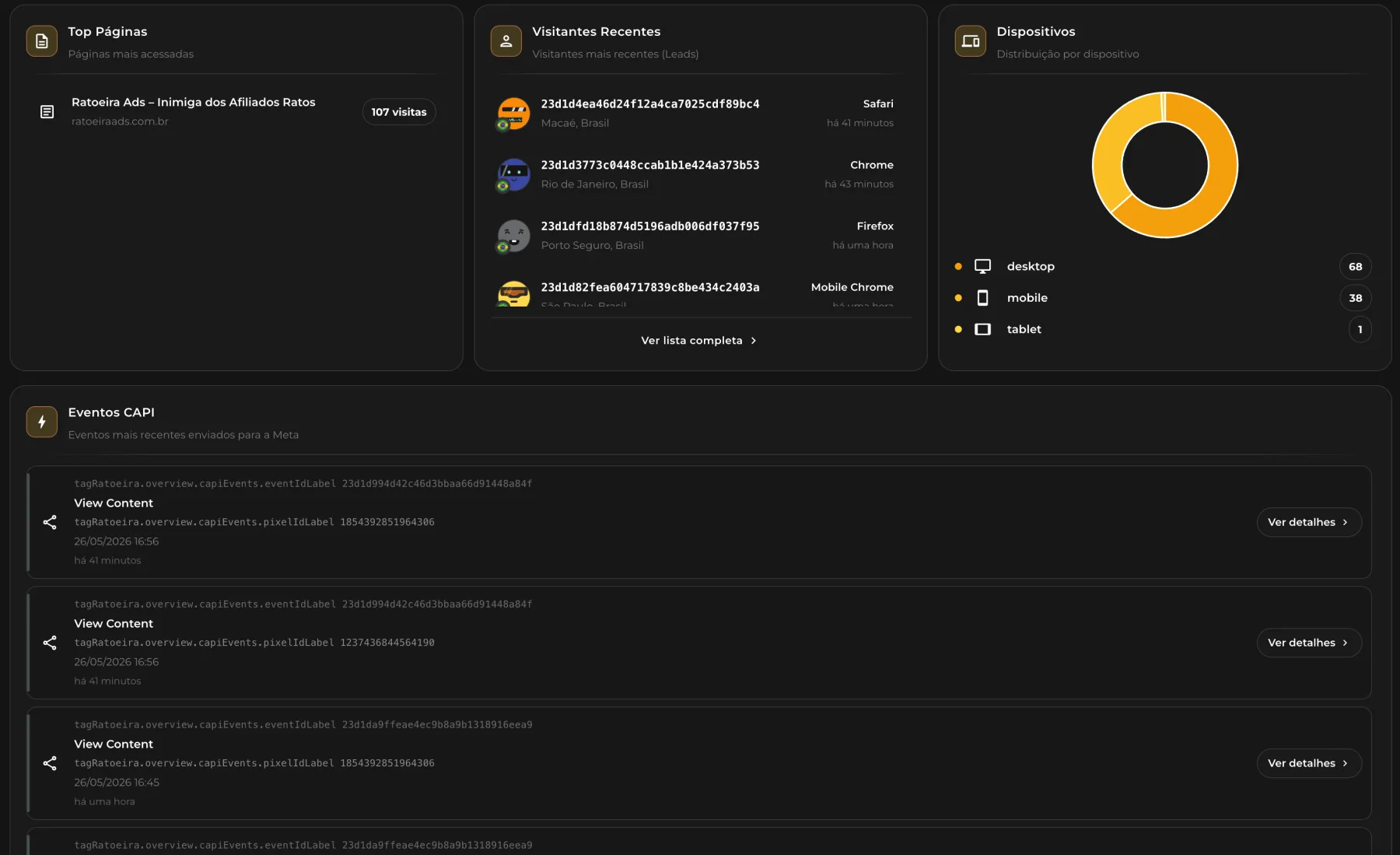
The ecosystem numbers give the scale of things:over 2,600 advertisers using the platform and over $81 million tracked. Designing a product for this audience taught me something that I carry into every project: paid traffic users don't want a pretty dashboard, they want a quick response with reliable numbers. Every interface decision, from table density to conversion event highlighting, was made in favor of reading speed. If you want to see how this materialized, thecomplete Ratoeira Hub caseit's in my portfolio, with the screens and the experience decisions behind them.
A design decision from this project worth mentioning: we resisted the temptation to transform the dashboard into an airplane cabin with forty graphics. The temptation was real, because there is no shortage of data on a tracking platform. But every additional metric on the home screen is stealing attention from the question that matters, and paid traffic users work with one hand on the budget and the other on the ad manager. What was left on the surface was the layered essentials: the immediate summary on top, the detail just a click away, and no number without context for comparison. Good data product is not what shows the most; is what makes the next decision obvious.
What signs show that your operation is losing conversions?
Not every operation needs an auditor to discover that it is bleeding data. These signs appear in the daily life of any manager, and each of them points to the same diagnosis: the pixel is telling a smaller story than the real one. If you score three or more, your lost conversions are not hypothetical; are budget line.
- Sales on the affiliate platform are consistently higher than conversions on Google Ads and Meta Ads, and the difference is over 15%.
- Campaigns that were converting well get worse “out of nowhere”, without changing the creative, page or audience — a classic symptom of an algorithm optimizing with mutilated data.
- Much of your traffic is iOS and your conversions reported on Meta have plummeted in recent years without any explanation from the market.
- You can't tell today which creative generated a specific commission that dropped last week.
- Your funnel depends on external checkout (Hotmart, Kiwify, Eduzz) and you never checked if the click parameters survive until then.
- The CPA calculated in the manager does not match the real CPA calculated in the cashier, and the divergence grows as the operation scales.
- Spikes in clicks without any sales, at strange times or regions, suggesting bot or competitor sabotage without IP blocking.
- You make the decision to pause or scale the campaign just by looking at what the manager shows, without crossing it with the affiliation platform.
Mistakes to avoid when implementing tracking on your own?
After months of watching advertisers migrate to Ratoeira Hub from home setups, I learned that mistakes repeat themselves with impressive regularity. Almost no one makes mistakes due to incompetence; it gets it wrong because server-side tracking looks deceptively simple. “Just send an event to the API” is the phrase that precedes three weeks of headache. These are the errors I saw the most:
- Send the event through the server and keep the pixel without deduplication. Result: each sale turns into two conversions, the manager celebrates fantasy numbers and Smart Bidding learns from inflated data. The unique event identifier is not detail; This is what separates redundancy from duplicity.
- Send conversion without enriched data. A naked server-side event, without hashed email and telephone numbers, results in fewer sales and clicks and throws away half the benefit. Match rate is where conversion recovery happens.
- Losing the parameters in the first redirect. The click arrives with gclid, src, sck and UTMs; A poorly configured redirect in the middle of the funnel erases everything, and the server is left without the link that justified its existence.
- Test with real conversion and pollute the account. Tracking setup is tested with a test event, debug window and separate environment, not with real sales that then need to be hunted down and corrected.
- Forget the assignment window and time zone. Conversion sent too late or with the wrong time stamp falls out of the window or messes up the report. Server clock is not precious.
- Treat tracking as a project with an end. Platform changes API, browser changes rules, checkout changes flow. Homemade setup without an owner dies within months, and dies in silence: the operation only finds out when the number doesn't add up.
- Measure everything and act on nothing. Beautiful dashboard with thirty metrics and no decision routine is a data museum. Good tracking is what ends in one optimization action per week.
The common thread behind these errors is always the same: tracking looks like an installation problem and is an operational problem. Installing is day one; keeping the link between click and sale alive, clean and deduplicated, every day, across four ad platforms and three checkout platforms, is the rest of your life. This is exactly why the affiliate market has migrated from homemade scripts to dedicated platforms: the cost of the tool is less than the cost of discovering, three months later, that the homemade setup was counting half of the sales.
What would I do in an affiliate operation today?
If I set up an affiliate operation from scratch today, the sequence would be clear and I would not trade the order. First: server-side tracking with double shipping from day one, before the first real invested. Not after the operation “proves that it works”, because it is precisely in the proof phase that the algorithm is learning, and I want it to learn from complete reality. Every day running with just a pixel is a day training the machine with mutilated data, and undoing wrong learning is more expensive than never having done it.
Second: I would treat the parameter taxonomy as part of the campaign, not as bureaucracy afterward. Before uploading any ad, I would define the convention of utm_medium, utm_campaign, utm_content, utm_term, src and sck, and no ad would be uploaded outside of it. Affiliates that scale without taxonomy become hostage to their own success: with ten campaigns you can remember them off the top of your head; with a hundred, improvisation becomes an illegible report and a decision in the dark.
Third: anti-fraud turned on before scaling. In Google Ads, I would configure the limit of clicks per IP on the first day of serious funding. I've seen niches where competitor sabotage was so routine that advertisers treated click fraud as a fixed cost, like accepting rain. It is not. It's a leak with a known address, and a known address blocks itself. And fourth: I would use a landing page with integrated tracking instead of a generic page with a hanging script, because every seam between tools is a point where the data dies without warning. It was this philosophy that I guided in the product, and it is the one that I would apply in my own operation: the shortest funnel between click and registration wins.
There is a fifth point, more about posture than configuration: I would measure the health of the tracking in the same way as the health of the campaigns. Once a week, cross platform sales with manager conversions. If the gap starts to open, something has broken, and the sooner I know, the less the algorithm learns wrong. Tracking is not invisible infrastructure that runs itself; It is an onboard instrument, and an onboard instrument is consulted.
And I wouldn't try to build any of that on my nails. I have already designed products in this market and I know the size of the problem: each ad platform has its API, its event formats, its deduplication rules and its pace of change; each affiliation platform has its own way of notifying sales; each checkout has its redirects. Keeping this network alive, alone, while operating the campaign, page and creative, is like having two jobs. The right question is not “can I do it?”, because you probably can; is “do I want this to be my second job for the next few years?” My answer, after seeing what happens inside a dedicated platform, is no.
How does the pixel show a smaller operation than yours?
The whole story fits in one sentence: between 25% and 40% of your conversions happen in a place that the pixel can't reach, and everything that depends on this vision, from automatic bidding to remarketing audiences, inherits blindness. Server-side tracking with double sending and enriched data is not a high operational sophistication; it is the minimum floor for anyone who wants Google and Meta to see the operation that really exists. The question is no longer “is it worth tracking properly?” and became “how much does it cost to keep tracking wrong?”.
If I could leave an order of priority for those who got this far, it would be this: first measure the hole, crossing the affiliation platform with the manager; then cover the hole with double sending and enriched die; then defend the budget with anti-fraud; and only then optimize creative and page, now on data that describes reality. Most operations do exactly the opposite, optimizing creative over a third of the signal and treating tracking as a technical matter for later. Then, in this market, it's usually too late: whoever sees more buys better media, and whoever buys better media wins the auction.
If you want to see how this architecture becomes a real product, this is the way to go.Ratoeira Hub casehere in the portfolio: the dashboard of pages, visitors, devices and events, Flash Pages, anti-fraud with IP blocking and the design decisions behind it all. And if your operation is losing conversions to the pixel today, find out whatRatoeira Hubin operation: tracking, anti-fraud and pages integrated from the first click, withvirtually 100% of conversions tracked. To talk about product design for data and performance, reach me athome page. Operations that see their own sales always beat those that guess.