
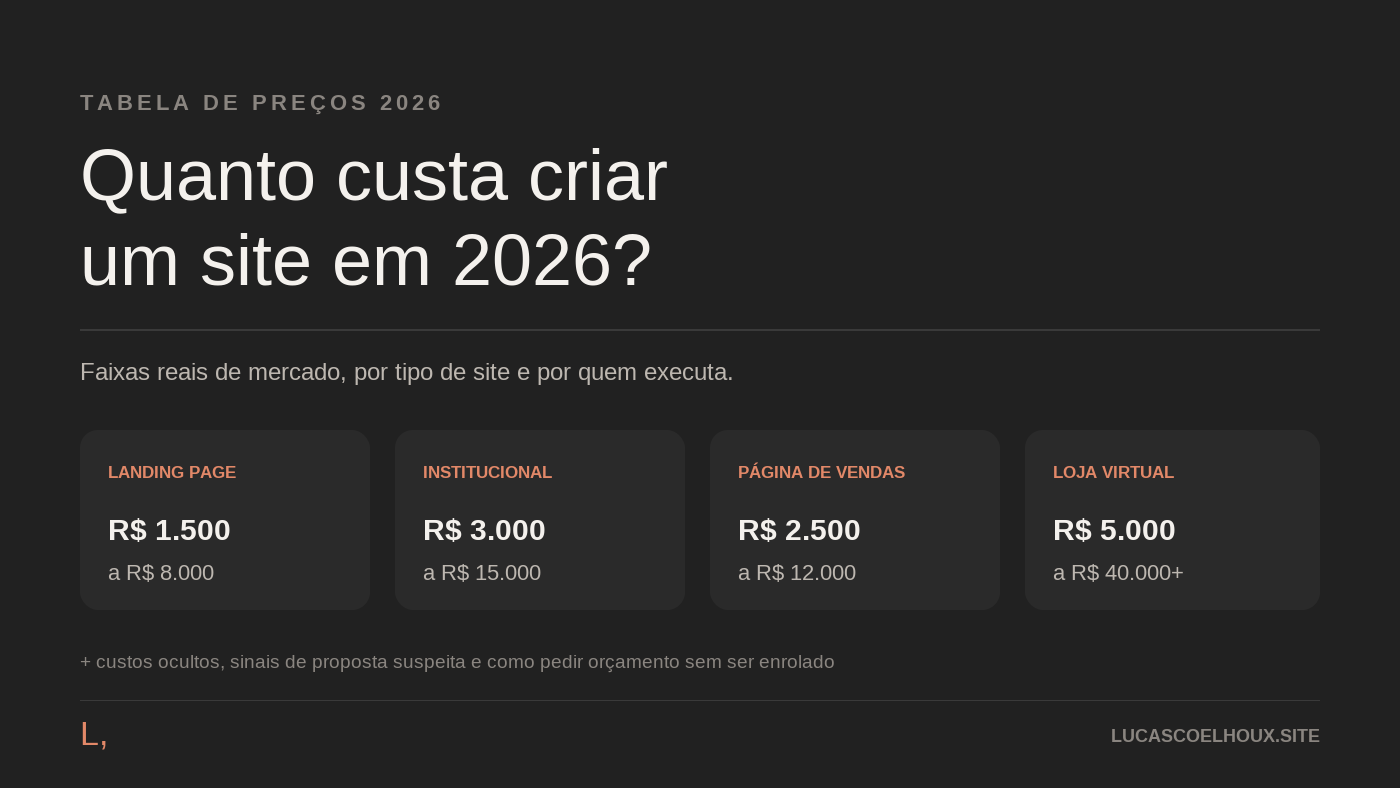
Creating a professional website in Brazil in 2026 costs between R$1,500 and R$40,000, depending on the type of website and who runs it. A landing page costs between R$1,500 and R$8,000, a business website between R$3,000 and R$15,000, a portfolio between R$2,000 and R$10,000, a sales page between R$2,500 and R$12,000 and an online store between R$5,000 and R$40,000 or more. To these values add the annual costs: domain (R$40 to R$120 per year), hosting (R$240 to R$1,800 per year) and maintenance, when contracted.
These ranges are market estimates, created based on the budgets I make myself, the values I see circulating among professional colleagues here in Campinas and the proposals that my clients show me when they reach me after receiving a number that doesn't add up. There is no official table: anyone who promises “the right price” on a website is selling certainty where there is only a range. What exists is a set of factors that pushes the value up or down, and that is what this article fully explains.
If you are researching how much it costs to create a website because you received proposals with a difference of ten times between the cheapest and the most expensive, you are not alone. This is the most common complaint I hear. A beauty clinic showed me three quotes for the same scope: R$800, R$6,500 and R$22,000. All three said “professional website”. In this guide I explain what each price range actually buys, where the money goes, what costs almost no one notices exist and how to ask for a comparable quote, without being fooled by a vague proposal.
Summary: how much does each type of website cost in 2026
This is the website creation pricing table that answered 90% of the questions I get, before any conversations about scope. Keep it as an initial reference: the values below are for websites made by a professional or independent studio in Brazil, with custom design, revised text, basic SEO configuration and ready-to-publish delivery:
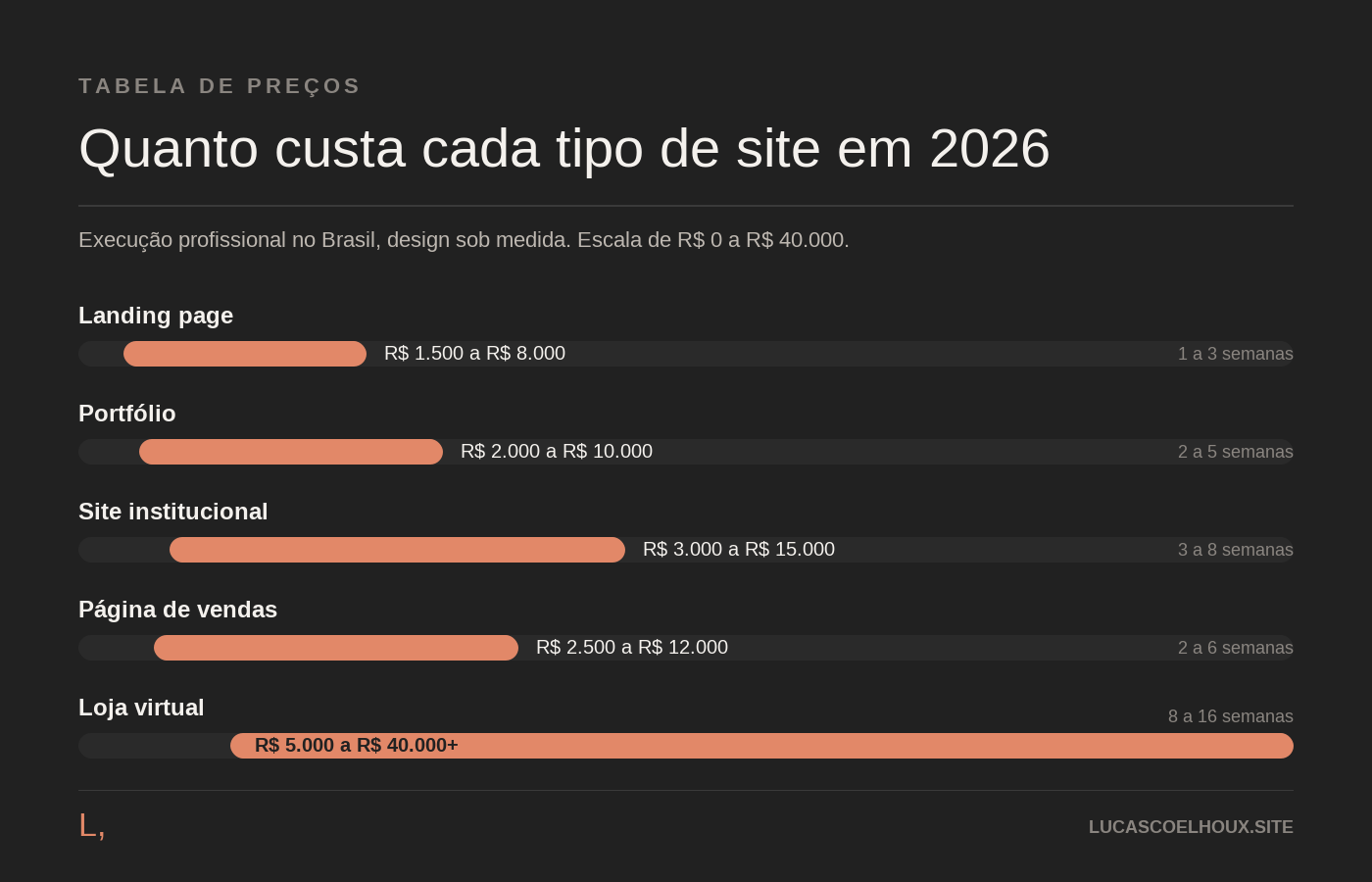
- Landing page: R$1,500 to R$8,000. One page, one objective, deadline of 1 to 3 weeks.
- Portfolio: R$2,000 to R$10,000. 3 to 6 pages to show work, deadline of 2 to 5 weeks.
- Business website: R$3,000 to R$15,000. 5 to 10 pages to present the company, deadline of 3 to 8 weeks.
- Sales page: R$2,500 to R$12,000. Long conversion page with persuasive copy, deadline of 2 to 6 weeks.
- Online store: R$5,000 to R$40,000 or more. Integrated catalogue, payment and shipping, 8 to 16 weeks.
- Annual recurring costs: R$500 to R$4,000 per year including domain, hosting and basic maintenance.
The number within the range depends on three things: how customized the project is, how much ready-made content you deliver and who executes it. A five-page business website with ready-made texts, good photos and a defined visual identity rests on the lower end of the range. The same website with writing from scratch, photo shoot, identity created together and integration with a scheduling system goes through the roof. In the next sections I detail each type and each factor.
What determines the price of a website?
Website price is not the price of a shelf product. It's more like renovation prices: two bathrooms of the same size can cost very different amounts depending on the finish, workmanship and what's hidden behind the wall. When I put together a budget, I look at five blocks of work, each of which can double the final amount:
- Scope and number of pages: each new page is additional design, text, review and programming.
- Tailor-made design or adapted template: total customization costs more because it requires research and decision-making, not just assembly.
- Content: texts, photos, videos and translations are included in the budget when the supplier is the producer.
- Features: simple forms are cheap; members area, integration with systems and manageable panel, no.
- Technical SEO and performance: structure for Google, loading speed and structured data require specialized hours.
Scope: the number of pages weighs less than the complexity of each one
The question “how many pages does the website have?” deceives. A single sales page, with twelve sections, social proof, price calculator and three call variations for A/B testing is more work than a simple eight-page business website. What costs is decision and implementation: each section needs hierarchy, text, image, mobile version and review. That's why a serious budget isn't determined by page count; It is closed by a list of sections and functionalities.
In practice, I ask the client for a list of what the site needs to do, not what it needs to have. “I need the patient to schedule an appointment via WhatsApp in two clicks” generates a much more accurate quote than “I want a beautiful, modern website”. The first sentence defines scope; the second defines taste, and taste cannot be priced honestly.
Custom design or template
Template is a ready-made design where you change the logo, colors and texts. It's legitimate to validate a deal in a hurry, and there are good templates. The cost drops because the research and visual design stage simply doesn't happen. Tailor-made design starts from scratch: I understand the business, study the competitors, design a structure for that specific audience and only then put on the clothes. This difference in process is what separates a R$2,000 project from a R$10,000 project, and it's also what separates a website that looks generic from one that looks like your company.
A quick test to find out what they are selling you: ask to see three of the supplier's previous works. If all three have the same structure, the same blocks and only change the colors, you are buying a template with makeup, even if the proposal says “exclusive layout”. It's not necessarily bad; The problem is paying a custom price for an assembly line product.
Content: the most underrated budget item
Half of the delays I see in website projects don't come from design or programming: they come from text that isn't enough. Those who hire usually assume that the content “somehow appears”, and those who execute sometimes assume that the client will write everything. When both of them miss expectations, the project stops halfway. Professional writing for a six-page business website adds between R$800 and R$3,000 to the budget, and is worth every dollar if the alternative is generic institutional text written in a hurry the day before delivery.
Photos follow the same logic. Image bank solves the filling, but the client feels the difference between a stock photo and a photo of the real restaurant, the real office, the real team. A professional part-time photo shoot in Campinas costs between R$600 and R$2,000, and for local businesses it is usually the investment with the best visual return per real spent.
Pricing table by type of website
Now the details of each track in the summary. In each type, I explain what goes into the floor, what pushes up to the ceiling and for how long the project usually occupies the schedule of those who execute it. Use this as a ruler when comparing proposals.
Landing page: R$1,500 to R$8,000
The landing page is the cheapest entry point: a page with a single objective, be it capturing contact, selling a service or publicizing an event. At the lower end of the range (R$1,500 to R$3,000) you will find template pages, with form and WhatsApp integration, delivered within a week. The ceiling (R$5,000 to R$8,000) includes tailored design, copy designed for conversion, careful animations, integration with CRM or email tool and tests on various devices.
It's the format I deliver most to local businesses that are starting to advertise on Google or Instagram: the page answers a question, asks for an action and nothing more. If you want to understand this format in depth, I wrote about the process on thewebsite and landing page services, with what is included in each stage.
Portfolio: R$2,000 to R$10,000
A portfolio website is for professionals who sell visual or intellectual work: architects, photographers, designers, specialist attorneys, and consultants. The structure usually has three to six pages (home, about, projects or case studies, and contact), with much of the work going into curating and presenting the projects. A R$2,000 portfolio organizes what you already have; one for R$10,000 builds a narrative around each case, with context, process, and results—the details that help convince discerning clients.
I live on the other side of that counter: this site you are reading is my portfolio, and cases like the one fromFits Youthey show the standard of depth that I consider necessary for a case to really sell. When the portfolio is well constructed, he works as a silent salesman: the client arrives at the first conversation already half convinced.
Business website: R$3,000 to R$15,000
The business website is the company's complete business card: who we are, what we do, for whom, where we are, how to talk to us. Five to ten pages, deadline of three to eight weeks. On the floor are projects with a ready-made identity, client texts and a lean structure. Those that include writing, configured blog, individual service pages, forms with logic and technical SEO worked page by page rise to the ceiling.
It is the type with the greatest variation in proposals on the market, because “business website” means very different things for each supplier. For some, it's a one-page template with anchors; for others, it's a ten-page project with a manageable dashboard. Before comparing prices, standardize the scope. If you are still defining this scope, my article onwhat to put on a business websitedetails section by section what cannot be missed.
Sales page: R$2,500 to R$12,000
Sales page is a long landing page, built to convert a specific offer: course, consultancy, digital product, mentoring. The price goes up because the main work is not visual, it is persuasive. Argumentation structure, objection breakdown, organized social proof, sequential calls to action: this is copywriting, and good copywriting is expensive because it pays its own cost. A R$2,500 page brings structure and design; one for R$12,000 includes professional copy, research with the public and variations for testing.
A rule of thumb that I use with clients: if the product sold costs less than R$200, a page in the low range will do the trick; If the ticket exceeds R$2,000, saving on the page means cutting the investment exactly where it pays off. The sales page is the only type of website where the text is worth more than the design, and I make a living designing interfaces.
Online store: R$5,000 to R$40,000 or more
E-commerce is another project category. In addition to the visible pages, there is a product catalog, cart, checkout, payment integration, shipping calculation, inventory management and transactional emails. On ready-made platforms (Nuvemshop, Shopify, Yampi and the like), a well-configured project costs between R$5,000 and R$15,000. Custom-made store, with its own panel and specific integrations, starts at R$20,000 and easily exceeds R$40,000.
The platform versus bespoke decision is financial before being technical: the platform charges a monthly fee (R$50 to R$500 per month, depending on the plan and volume) but makes entry cheaper; Own development eliminates monthly platform fees but requires ongoing maintenance. For most of the small businesses I serve, a well-configured platform wins in the first two years. Tailor-made only when the operation already has a volume that justifies the bill.
Price list for those who do it: freelancer, agency or do it yourself
The same scope changes price radically depending on who executes it, because what you buy changes. Freelancer sells hours to an experienced person. Agency sells process, team and structure. Website builders (Wix, WordPress with Elementor, Squarespace) sell the tool and charge you for the time to learn and set it up. None of the three is intrinsically better: the right choice depends on the moment of the business and how much your hour is worth.
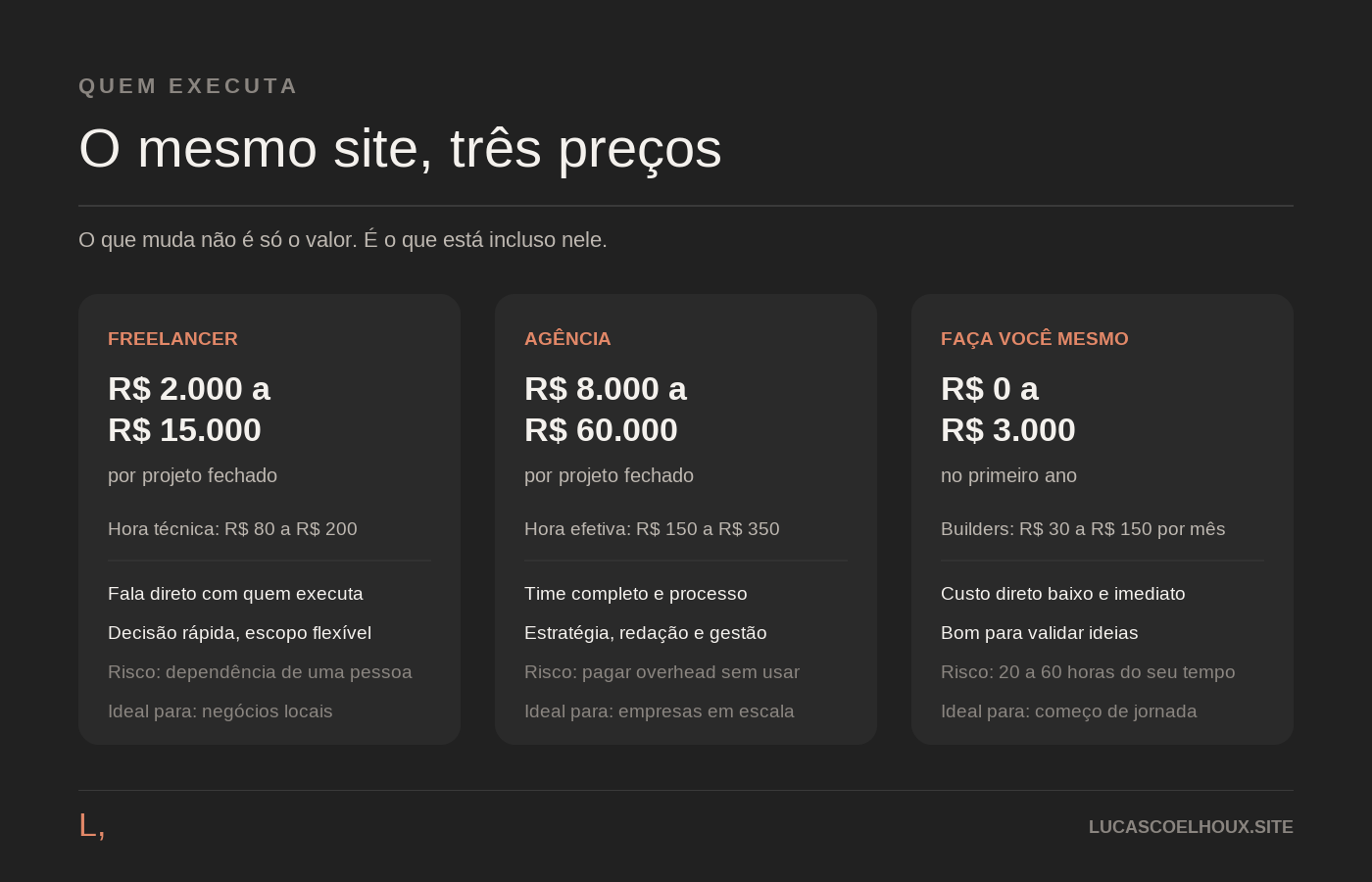
Freelancer: R$2,000 to R$15,000 per project
How much does a freelance web designer charge in Brazil in 2026? Hours cost between R$80 and R$200, depending on seniority and specialization. A business website project takes between 40 and 80 hours, which explains the closed project range. The advantage is to speak directly with the person executing it: without an account manager passing on messages, the decision is quick and the scope is discussed with the person who will design it. The risk is dependence on just one person: if they disappear, get sick or have a busy schedule, your project will feel it.
Agency: R$8,000 to R$60,000 per project
Agency charges more because it delivers structure: strategist, writer, designer, developer, project manager. The effective hour is between R$150 and R$350. For companies that need joint rebranding, integrated campaigns or several websites throughout the year, the price is justified by the coordination. For the restaurant on the corner that needs an online menu and reservations via WhatsApp, the agency is an ant-killing cannon: you pay overhead that you don't use.
Do it yourself with builders: R$0 to R$3,000 in the first year
Website builders cost between R$30 and R$150 per month. The calculation that no one takes is their time: putting together a decent page in a builder takes 20 to 60 hours for someone who has never done it, between learning the tool, struggling with alignment and writing the texts. If your hour is worth R$50, the “free” website cost R$1,000 to R$3,000 in time, and the result often looks exactly like a DIY build. To validate an idea or hold the line for six months is an honest path. To represent a business that lives off its own image, the savings tend to be expensive.
There is also a fourth way that has become fashionable: generating the entire website with artificial intelligence. The tools have improved and the initial results are impressive in demonstration. In practice, the generated website needs someone to review the structure, correct generic texts, take care of SEO and connect domain and forms: in other words, it needs a professional on top. I see AI as accelerating the work of those who already know what they are doing, not as a replacement. I use it myself in my process, and the price I charge reflects the end result, not the tool.
Billing models: closed project, hourly or monthly fee
In addition to who does it and what is done, it matters how it is charged. Three models dominate the market, and each distributes the risk in a different way between you and the supplier.
Project closed
Defined scope, defined price, defined deadline. It's the model I prefer and the safest for those hiring for the first time: the risk of overruns lies with the supplier, who should know how to measure their own work. Payment is usually divided into two or three installments linked to deliveries (input, layout approval, publication). Be wary of those who ask for 100% in advance or those who cannot agree on a price even with a detailed scope.
Technical time
Fair for maintenance, continuous improvements and scope impossible to close at the beginning. Dangerous for a new project, because the incentive is reversed: the longer it takes, the more expensive it becomes. If you are hiring by the hour, demand an estimated interval (“between 30 and 45 hours”) and a report of what was done in each block of hours. Without this, the invoice at the end of the month becomes a surprise.
Monthly fee (website as a service)
Some suppliers charge between R$150 and R$600 per month and deliver the website at no initial cost. The bill looks great until you do the multiplication: in two years, R$300 a month adds up to R$7,200, and in many contracts the site isn't yours if you cancel. Before signing, ask two things: who owns the domain and files, and how much it costs to get the website. If the answer is evasive, it's getting expensive.
Hidden costs: what is almost never in the proposal
The price of the project is just the entry fee. A live website has recurring costs that, combined, are between R$500 and R$4,000 per year for a small business. Honest Proposal lists them all from the beginning; opportunistic proposal lets you find out after signing. Here is the complete list for you to demand transparency:
- Domain: R$40 per year for .com.br at Registro.br (official table value), between R$60 and R$120 per year for .com at national registrars.
- Accommodation: R$20 to R$150 per month. Static and lightweight websites run on cheap or free plans; Heavy WordPress and online store require bigger plans.
- SSL certificate: free via Let's Encrypt on most serious hosts; Anyone who charges R$300 per year for a “security certificate” needs to justify it.
- Maintenance: R$150 to R$800 per month when contracted, covering updates, backups and small adjustments.
- Professional email: R$30 to R$80 per month per box (Google Workspace, Microsoft 365) if not included.
- Tools and plugins: R$0 to R$200 per month in form, analytics, automation or e-commerce platform licenses.
The domain deserves its own paragraph because it is the item where I see the most confusion. Register a .com.br directly onRegistro.br, the official registration body in Brazil, costs R$40 per year and takes ten minutes. Even so, I receive clients paying R$350 per year for “domain renewal” to third parties, and worse: clients who discovered too late that the domain was registered with the previous agency’s CNPJ, not theirs. Golden rule: your business domain is always in your account, with your email and document. Whoever builds the website manages it; You are the owner.
Regarding maintenance, an honest distinction: a well-built static website hardly needs corrective maintenance, because it has no database or plugins to break. WordPress and online stores need constant updating for security. When someone pushes you a monthly maintenance plan for a five-page static website, ask exactly what will be done each month. If the answer is “monitoring and peace of mind,” you’re buying insurance on something that rarely breaks.
What makes a website more expensive (and what doesn't)
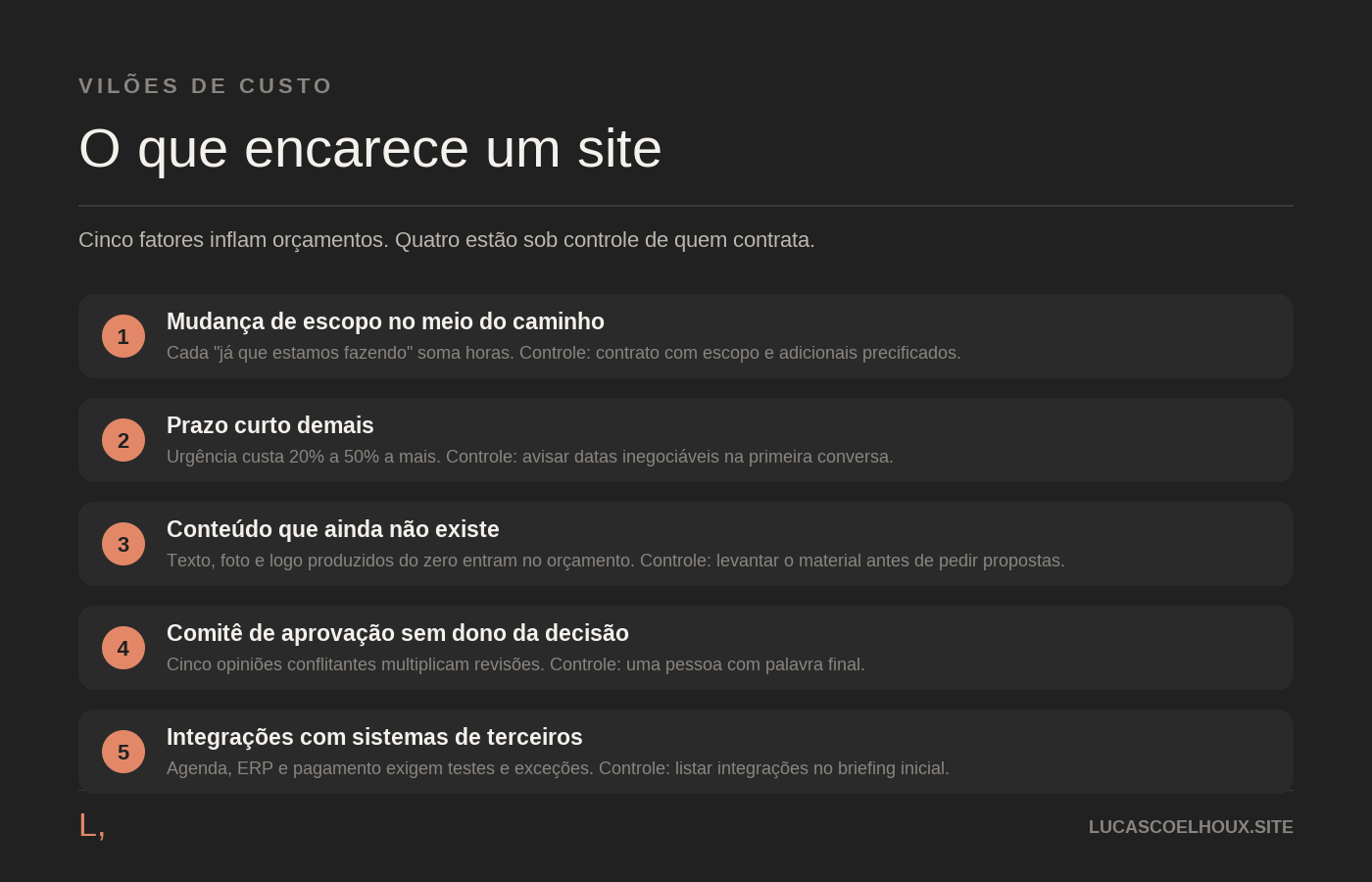
After years of budgeting projects, my list of cost villains surprises those who expected “beautiful design” at the top. What is most expensive, in order: changing scope midway, too short a deadline, content that doesn't exist yet, integrations with third-party systems and approval committees with five people giving conflicting opinions. Note that four of the five are in the hands of those who hire, not those who execute.
The classic case is that of a law firm that hires a six-page website and, in the third week, decides that it also needs a blog, publications area, client portal and an English version. Each “since we are doing it” seems small in isolation; Added together, they double the project. An experienced supplier protects both sides with a contract that lists the scope and prices separately. An inexperienced supplier silently absorbs until the deadline expires, or passes on everything without warning and sours the relationship.
What is not expensive, contrary to common sense: well-made discrete animations, dark mode on a new website (when foreseen from the beginning), basic accessibility and basic technical SEO. These items cost little when planned at the beginning and a lot when added at the end. The moral is always the same: the cheap comes from planning, the expensive comes from improvisation.
How long does it take to create a website?
Term and price go hand in hand, so it’s worth putting both in the same conversation. The ranges I see in practice, for professional execution with content arriving on time: landing page from 1 to 3 weeks, portfolio from 2 to 5 weeks, business website from 3 to 8 weeks, sales page from 2 to 6 weeks and online store from 8 to 16 weeks. Anyone who promises a complete business website in five business days is either reusing templates without telling you, or underestimating their own work. Both hypotheses deserve a direct question before signing.
The secret that no proposal reveals: the bottleneck is almost never execution. In my project spreadsheets, the time spent waiting for a decision from the client (layout approval, missing text, photo that will be sent next week) is often equal to the production time. That's why serious proposals divide the schedule into stages with those responsible on both sides: I'll deliver the layout by that day, you return comments by that day. A schedule without a customer return date is a make-believe schedule.
There is a direct relationship between rush and cost. Normal deadline allows the supplier to fit your project among others; An urgent deadline requires nights, weekends and rescheduling of the schedule, and this has a price, generally between 20% and 50% additional. If the date is non-negotiable (scheduled launch, event, contracted campaign), let us know in the first conversation, not in the second week. The opposite is also true: those who have deadline flexibility can negotiate better, because they give the supplier the scarcest thing they have, schedule predictability.
To close the matter, a reference number: adding production and waiting, the average business website that passes through my hands goes from the first contact to the air in around six weeks. It can be done in three with ready-made content and quick decisions; I've seen it stretch to four months when the approval committee had five people and none of them owned the decision. Your website's deadline says a lot about the organization of your business, and this is a truth that applies to both sides of the table.
Signs of a suspicious proposal (too cheap to be true)
There is a physical floor for the price of a website: the time of someone competent. A serious landing page takes at least 15 to 25 hours between briefing, design, text, programming, testing and publication. When a proposal for a “complete website for R$500” appears, the math doesn’t add up, and something is being cut without warning. The classic cuts:
- Generic template sold as an exclusive layout, with the same structure as dozens of other websites.
- Mass-generated text, without research into your business, full of phrases that would work for any company.
- Domain and hosting registered in the name of the supplier, making you hostage to their renewal.
- No mention of deadline, number of revisions or acceptance criteria: the project ends when the supplier gets tired.
- Lack of a verifiable portfolio or clients you can contact before closing.
- One-line contract, no scope, no schedule and no exit clause.
Being too cheap has a late cost that is rarely included in the bill: redoing. A good part of my business website projects were born from a first R$800 website that held up the business for a year: it didn't appear on Google, it didn't load properly on my cell phone and no one could update it. The customer paid twice for the same website, and the second installment included the expense of undoing the first. Economy in the wrong place is the most expensive way to hire.
“If the proposal fits into a two-line WhatsApp message, your website's problem will also be solved in two lines: when it fails, the answer will be “that's it”.”
— Advice I give to every customer before comparing prices
How much does it cost to create a website in Campinas and the region?
I work creating websites in Campinas and monitor the market in the metropolitan region: Valinhos, Vinhedo, Paulínia, Sumaré, Hortolândia and the Circuito das Frutas area. Local prices follow the national ranges I showed above, with two particularities. The first: competition with agencies in São Paulo capital pushes some budgets upward, but the region's cost of living rule keeps the values of freelancers and local studios between 10% and 25% below the capital for equivalent scope.
The second particularity is the business profile. Campinas has a huge density of clinics, offices, law and accounting firms, medium-sized industries and high-ticket restaurants. These are businesses in which the customer's decision depends on trust, and local trust is built with a website that shows the address, team, reviews and real photos. For this profile, the investment that returns the most is the well-designed business website combined with a well-maintained Google profile, not the online store or the app.
If you are from the region and want concrete numbers for your case, my information pagewebsite creation in CampinasIt shows how I work, what is included in each project and the contracting formats. I prefer to talk about scope before talking about price, because a serious budget comes from a clear scope, and the first diagnosis costs nothing.
How to create a budget without being lazy
The game changes when you arrive at the conversation with your homework done. A good supplier loves a prepared customer, because clear scope means less rework; A bad supplier gets confused, because his margin lies in your doubts. The script I would give to a friend:
- Write on a page what the site needs to do: the objectives, the imagined sections and three sites that you consider to be references.
- Collect content that already exists: logo, photos, old texts, catalogues. Each item ready reduces the budget.
- Ask for three proposals with the same brief, always in writing, and compare item by item, not just the total.
- Require the proposal to list: scope, deadline, number of review rounds, what is included, what is not and who owns the domain, files and content.
- Ask what the recurring costs will be after delivery, with amounts per year.
- Speak to a previous customer of the supplier before signing. Ten minutes on the phone are worth more than ten testimonials on the website.
A comparison detail that catches a lot of people: proposals with different scopes do not compare based on the final price. A proposal of R$4,000 without writing and without SEO can be more expensive than R$7,000 with both, when you hire the writing outside and discover that the site was not structured for Google. Normalize the scope before deciding, or you'll be comparing apple to apple kit.
Do you want an honest quote for your website?
I'm a web and product designer in Campinas, and a transparent budget is part of my service, not a favor. Every proposal I send details scope, deadline, review steps, recurring costs and what stays with you at the end of the contract: domain, files and content, always in your name. If your project doesn't fit into what I do, I'll say so in the first conversation and indicate the most sensible path, even if the path isn't mine.
To request a quote, call me atwebsite creation page in Campinasor byhome page. Bring what you have: an idea in two sentences is enough to get started. I return it with scoping questions and then a closed proposal, the kind that fits on a page and survives being read by an accountant.
Website Creation Pricing FAQs
How much does a simple one-page website cost?
A one-page website (landing page) costs between R$1,500 and R$8,000 with a professional, depending on bespoke design, copy and integrations. With website builders, the direct cost drops to $30 to $150 per month, but add 20 to 60 hours of your own time to put together something presentable.
How much does a web designer charge per hour in Brazil?
Freelancers charge between R$80 and R$200 per hour in 2026, depending on seniority and specialty. Agencies work between R$150 and R$350 per effective hour. For a new project, prefer a closed price per scope: the risk of overruns lies with the person executing it, who is the one who can measure the work.
Is it worth paying a monthly fee for a website?
It depends on the contract. Plans from R$150 to R$600 per month with no initial cost add up to R$3,600 to R$14,400 in two years. Before signing, confirm who owns the domain and files and how much it costs to migrate. If the site is not yours when you cancel, the monthly fee is rent disguised as an investment.
Why do website budgets vary so much between professionals?
Because “making a website” describes very different scopes: adapted template or custom design, with or without writing, with or without technical SEO, with or without integrations. Compare item by item and standardize the briefing between suppliers. A tenfold difference between proposals almost always means tenfold different scopes, not a tenfold better price.
Could a cheap website be expensive in the future?
It can, and it happens often. The classic late costs are redoing the website because it doesn't appear on Google, paying ransom for a domain registered in the name of the supplier and losing months of advertising pointing to a page that doesn't convert. The reliable price exists, but it comes with a clear contract and a verifiable portfolio.
How much does it cost to maintain a website per year?
Between R$500 and R$4,000 per year for a small business: domain (R$40 to R$120), hosting (R$240 to R$1,800) and optional maintenance (R$1,800 to R$9,600 per year, when contracted). Well-constructed static sites are at the base of the strip; WordPress and virtual stores, at the top, as they require constant updates.
Can I create a website alone without knowing how to program?
You can do it using builders like Wix, Squarespace or WordPress with a visual editor. The direct cost is low (R$30 to R$150 per month), but allow 20 to 60 hours to learn and assemble. To validate an idea works; to represent a business that lives off its own image, the result usually betrays the origin.
What do I need to submit to receive a website quote?
Three things are enough for a serious budget: the purpose of the site in one sentence, the sections or pages you envision, and two or three reference sites. If there are already logos, texts and photos, please let us know. With this, an experienced professional returns the scope, deadline and price agreed in a few days, without the need for a marathon meeting.